

Explore collections, university history, art, rare books, and manuscripts.
Our Island Homes: Paintings from the Bryant West Indies Collection
Chattel House by Cheryl S. Jorgenson
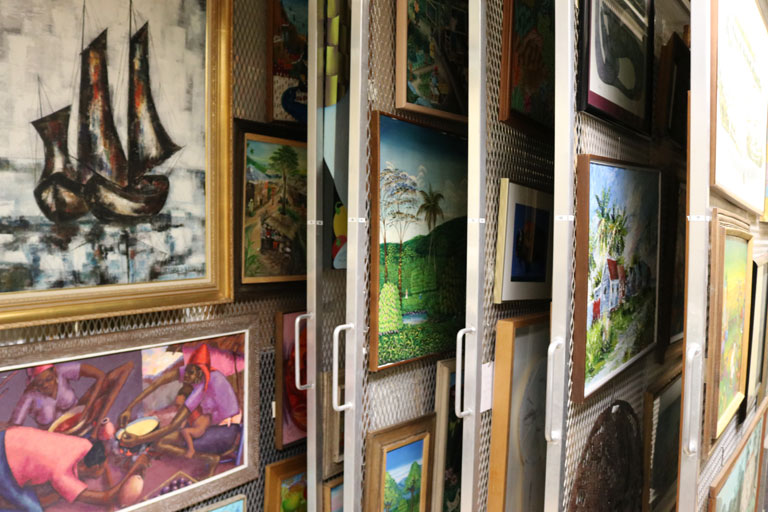
The paintings on exhibit in Our Island Homes illustrate
the typical dwelling found in the West Indies. The vernacular style homes include
Chattel , Cunucu and Shotgun styles. The materials and
techniques of these structures blend native, European and African architectural
styles, reflecting the heritage of the islanders. For artists in the West Indies,
these homes have provided inspiration and appear often in their artwork.
The Chattel house is found throughout the Lesser Antilles. It derives its
name from the old feudal term for movable property. The first chattel houses were
the homes of plantation workers, so named by workers in Barbados. A good example
of this type of dwelling is found in Cheryl S. Jorgenson's Chattel House
. The Chattel houses are designed to be easily dismantled and moved. After
emancipation, a plantation worker's employment was highly transient in nature, and
it was less expensive to move a house than build another. They are typically
raised off the ground and set on stone or concrete pillars, usually consisting of
two rooms and a verandah or porch in the front of the house. Weatherboard
and corrugated metal siding are popular construction materials. In old houses,
the windows were shutter-like jalousies that could be opened for circulation and
protected against hurricanes when closed. Today, glass windows with shutters are
more typical. Porches are often trimmed with white gingerbread fretwork.
Cunucu House and Dividivi Tree
by Florence Lo
Another style of architecture unique to the islands is the Cunucu house.
Found predominantly on the island of Aruba, cun ucu is a Papiamento word
for countryside, referring to the rugged interior of the island. The style again
reflects a blending of traditional European and native styles resulting in a uniquely
Caribbean dwelling. This type of home is captured in Florence Lo's Cunucu House
and Dividivi Tree . A cunucu house consists of a central section with one or
two annexes and a built-on kitchen. The kitchen chimneys are usually distinctive,
in a style the Arubans call fagon . The houses typically have sidewalls
extending all the way to the top, with one side of the pitched roof flattened off
with a gully to collect rain. They are brightly painted with red tile roofs. Unlike
the chattel houses, the Aruban homes have thick plaster walls.
House in Carrington Village by
Fielding Babb
The Shotgun style home is a Central African influenced vernacular style
thought to have originated in the West Indies and spread to the United States in
the early nineteenth century. The rooms of the house are arranged one behind
the other with the gable side facing the street. In this way, a shotgun could
be fired through the doorways without hitting anything. The rooms tend to be quite
small and open into each other. These are framed houses with corrugated metal
roofs. Fielding Babb's House in Carrington Village shows a good example
of some shotgun houses in Barbados.
The front porches of the Chattel and Shotgun house styles as well
as the traditional American home can also be attributed to th e African influence.
It is clear from an exploration of these vernacular architectural styles that the
homes of the West Indian islanders are heavily influenced by the cultural heritage
and environment of the builders. An example of the African influenced plantation
worker huts can be found in Grene Fuhring's Old County Home . Note the
thatched roof and wattle and daub walls of the hut.
Old Country Home by Grene Fuhring
Crain, Edward E. Historic Architecture in the Caribbean Islands
. Gainesville, FL: University Press of Florida, 1994.
Turner, Jane, ed. Encyclopedia of Latin American & Caribbean Art . Grove
Encyclopedia of the Arts of the Americas. New York: Grove's Dictionaries, Inc.,
2000.